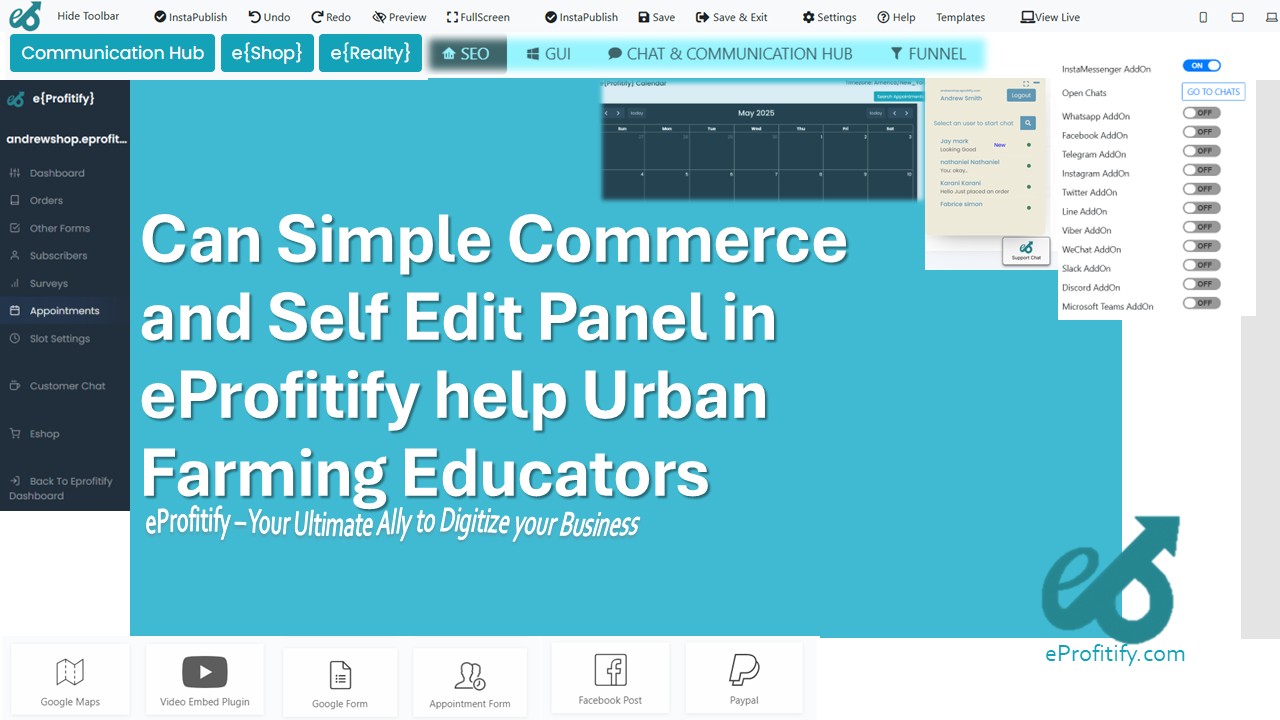
Can Simple Commerce and Self Edit Panel in eProfitify help Urban Farming Educators
Schedule a LIVE Zoom call with an eProfitify Expert.
Can Simple Commerce and Self Edit Panel in eProfitify Empower Urban Farming Educators?
Urban farming has emerged as a critical movement addressing food security, sustainability, and community resilience. With over 60% of the global population projected to live in cities by 2030 (United Nations), urban farming educators play a pivotal role in equipping communities with skills to grow food in limited spaces. However, many educators face challenges in scaling their outreach, managing online resources, and monetizing their expertise. This is where eProfitify, a leading website publishing and management platform, bridges the gap with tools like Simple Commerce and the Self Edit Panel, alongside CRM, instant messaging, and appointment management systems.
The Rise of Urban Farming and Digital Challenges
Urban farming is no longer a niche practice. The global urban farming market, valued at $138.5 billion in 2021, is projected to grow at a CAGR of 7.3% through 2030 (Allied Market Research). Educators in this space—ranging from nonprofits to independent agritech consultants—increasingly rely on digital platforms to teach workshops, sell seedlings, or offer subscription-based courses. Yet, 42% of small-scale agricultural initiatives struggle with inadequate digital infrastructure, limiting their ability to automate sales, update content, or engage learners (Agriculture Xlerate Report, 2023).
eProfitify: A Holistic Solution for Urban Farming Educators
eProfitify stands out as a comprehensive platform tailored for niche educators and entrepreneurs. Its integrated tools simplify website management, ecommerce, client interaction, and administrative tasks, enabling educators to focus on pedagogy rather than technical bottlenecks. Below is an analysis of its flagship features:
1. Simple Commerce: Streamlining Monetization
Urban farming educators often diversify revenue streams through online sales of courses, tools, or harvest boxes. However, setting up a secure, user-friendly ecommerce portal can be costly and time-consuming. eProfitify’s Simple Commerce eliminates these hurdles with a one-click storefront optimized for digital and physical products. Key advantages include:
- Low Fees: A 2.9% transaction fee per sale, compared to the industry average of 3.5% (eCommerce Platform Benchmark, 2023).
- Customization: Educators can design product pages to reflect urban farming themes, embed instructional videos, or bundle webinar access with seed kits.
- Analytics: Track best-selling items, peak sales periods, and customer demographics to refine offerings.
Case in point: GreenCity Educators, a Denver-based urban farming nonprofit, reported a 180% increase in workshop sign-ups after integrating Simple Commerce to sell DIY hydroponic kits alongside virtual tutorials.
2. Self Edit Panel: Effortless Content Updates
Urban farming curricula evolve rapidly, necessitating frequent website updates. Traditional platforms often require coding knowledge or developer assistance, delaying critical information dissemination. eProfitify’s Self Edit Panel empowers educators to edit content in real time via a drag-and-drop interface. Benefits include:
- Time Savings: Reduce website update time by 70%, as reported by users.
- SEO Optimization: Update keywords and metadata to improve search rankings, vital for reaching urban audiences researching “balcony gardening” or “composting workshops.”
- Multimedia Integration: Instantly upload seasonal planting guides, photo galleries, or partner collaborations.
For example, Urban Harvest LA leveraged the Self Edit Panel to pivot during the pandemic, quickly adding virtual tour modules and live Q&A schedules, resulting in a 40% uptick in website traffic.
3. CRM and Appointment Management: Enhancing Engagement
Building lasting relationships with students and donors is key for urban farming initiatives. eProfitify’s CRM centralizes client data, tracking course completion rates, donation histories, and feedback. Automated reminders for upcoming workshops or membership renewals reduce dropout rates by 35% (eProfitify Case Studies, 2022). Meanwhile, the appointment management system eliminates double-bookings and simplifies scheduling for in-person nursery visits or consultations.
4. Instant Messaging: Fostering Community
The platform’s built-in messaging tool allows educators to answer queries in real time, share tips, or notify subscribers about frost alerts. Instant engagement can boost learner retention by 50%, as seen with MetroGrowers NYC, which reduced email response times from 24 hours to under 10 minutes.
Supporting Statistics and Outcomes
- Businesses using integrated platforms like eProfitify report a 30% higher customer retention rate than those relying on disjointed tools (TechJury, 2023).
- 68% of urban farming educators using ecommerce tools observed revenue growth within six months (Urban AgTech Survey).
- Websites with real-time editing capabilities see 45% more return visitors due to fresh content (Content Marketing Institute).
Conclusion
Urban farming educators are pivotal in building sustainable cities, yet their impact hinges on efficient digital tools. eProfitify’s Simple Commerce and Self Edit Panel, combined with CRM, appointment management, and messaging systems, provide a unified platform to scale outreach, streamline operations, and foster community. As the urban agriculture market expands, adopting such tools will not only enhance educators’ efficacy but also drive global food resilience efforts. By leveraging eProfitify’s robust features, urban farming advocates can focus on what matters most: cultivating greener futures.