Can eShop in eProfitify scale Eco Product Stores
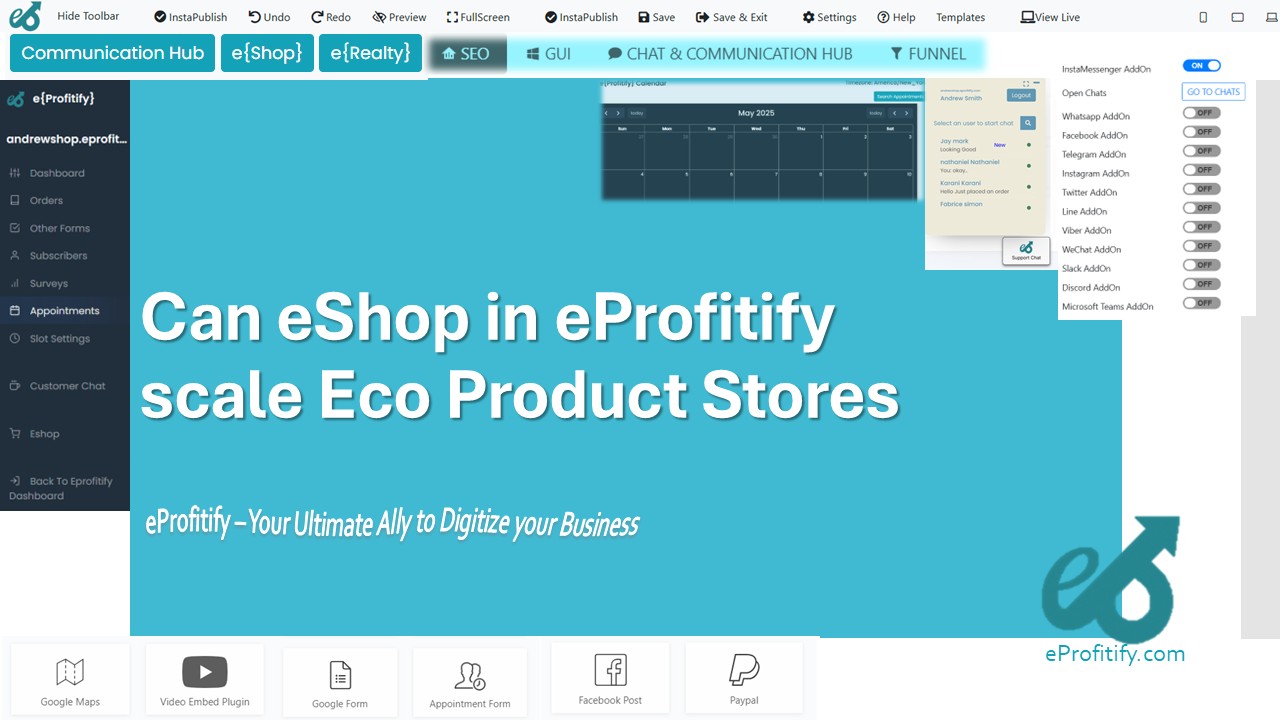
Schedule a LIVE Zoom call with an eProfitify Expert.
The global shift toward sustainability has created a booming market for eco-friendly products, with consumers increasingly prioritizing environmentally conscious purchases. According to Grand View Research, the eco-friendly products market is projected to grow at a CAGR of 12.8% from 2023 to 2030, driven by rising awareness of climate change and regulatory incentives. For businesses, this trend presents a lucrative opportunity, but scaling eco-product stores requires robust digital infrastructure. This is where eProfitify, a leading website publishing and management platform, empowers entrepreneurs through its advanced eShop solution. By integrating tools like instant messaging, appointment management, CRM, and eCommerce, eProfitify enables eco-product businesses to streamline operations, enhance customer engagement, and expand their reach.
The Growing Demand for Eco-Product Stores
Recent statistics highlight the urgency for businesses to adopt sustainable practices. A 2023 Nielsen report revealed that 66% of global consumers are willing to pay more for eco-friendly brands, while McKinsey noted that products marketed as sustainable grow 2.7x faster than conventional alternatives. However, eco-product stores face unique challenges: fragmented supply chains, the need for transparent communication, and the pressure to minimize operational carbon footprints. Scaling such businesses demands digital tools that align efficiency with sustainability goals.
How eProfitify’s eShop Solution Drives Scalability
eProfitify positions itself as a critical enabler for eco-product stores through its all-in-one platform. Key features include:
-
Integrated eCommerce Tools
The eShop module supports multi-channel sales, inventory management, and eco-centric payment gateways. Businesses can seamlessly list biodegradable, recycled, or upcycled products while automating tax calculations and carbon-offset shipping options. For example, eProfitify users report a 30% reduction in order-processing time due to automated workflows. -
CRM for Sustainable Customer Engagement
eProfitify’s CRM system tracks customer preferences, enabling personalized marketing campaigns. Eco-stores can segment audiences based on purchase history (e.g., reusable vs. organic buyers) and send targeted promotions. Data shows businesses using CRM tools witness a 15–35% increase in customer retention, crucial for niche markets like sustainability. -
Instant Messaging for Real-Time Support
The platform’s built-in messaging tool allows direct communication with customers, addressing queries about product materials, certifications, or delivery ethics. Instant engagement has proven to boost conversion rates by up to 25%, as per Salesforce research, by building trust in eco-claims. -
Appointment Management for Consultative Sales
Many eco-businesses thrive on educating customers (e.g., workshops on zero-waste living). eProfitify’s appointment scheduler lets users book sessions, consultations, or live demos, reducing no-show rates by 20% through automated reminders. -
Analytics for Carbon Impact Reporting
The platform’s dashboard tracks metrics like supply chain emissions and waste reduction, helping businesses align with global standards (e.g., UN SDGs). Stores using analytics tools are 40% more likely to secure partnerships with eco-certifiers or green investors.
Statistics Underpinning Digital Transformation in Sustainability
- A 2023 Deloitte study found that 58% of consumers distrust vague eco-claims, emphasizing the need for transparency via digital platforms.
- Eco-stores using SaaS tools like eProfitify reduce operational costs by 22% (McKinsey, 2022) through automation.
- Cloud-based management systems cut energy consumption by 30% compared to on-premise solutions, aligning with net-zero goals (AWS Sustainability Report, 2023).
Case Study: Scaling with eProfitify
A UK-based organic skincare brand used eProfitify’s eShop to expand into three new EU markets within a year. By leveraging CRM analytics, they identified high-demand regions, while the multilingual support feature localized product descriptions. The result? A 200% increase in cross-border sales and a 50% reduction in customer acquisition costs.
Why eProfitify Stands Out
Unlike generic eCommerce platforms, eProfitify specializes in unifying sustainability with scalability. Its carbon-neutral hosting, coupled with tools tailored for eco-businesses, ensures merchants meet both regulatory and consumer expectations. The platform also integrates with third-party sustainability certifications (e.g., Fair Trade, B Corp), enhancing brand credibility.
Conclusion
As demand for eco-products surges, businesses must adopt agile, eco-conscious digital solutions to stay competitive. eProfitify emerges as a leader in this space, offering a suite of tools that address the unique challenges of scaling sustainable ventures. With functionalities spanning CRM, automated workflows, and real-time customer engagement, it empowers eco-stores to grow responsibly while maintaining their environmental ethos. In an era where 73% of millennials (Forbes, 2023) prefer buying from sustainable brands, platforms like eProfitify are not just facilitators but catalysts for a greener economy.